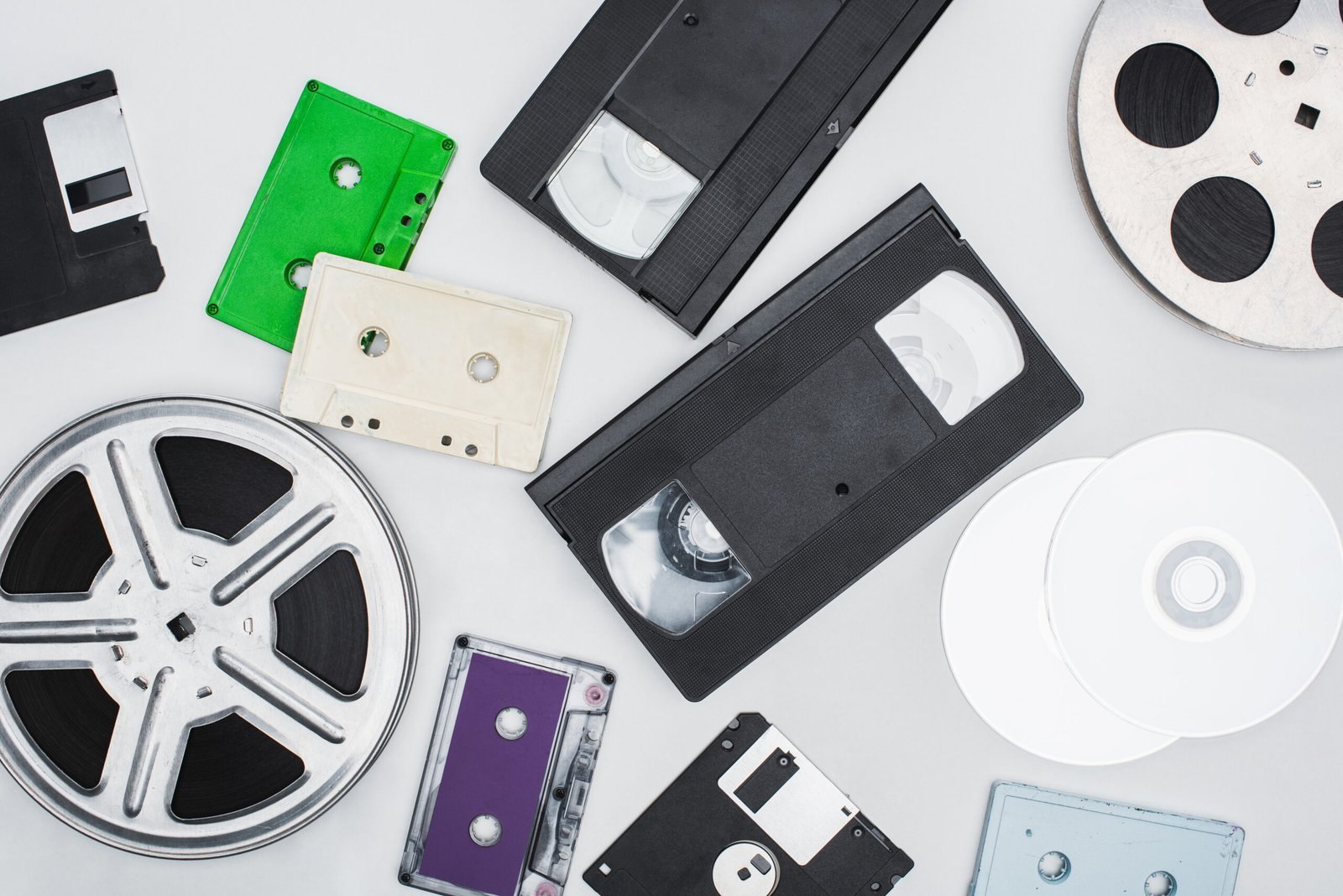
All analog media is in a state of decay, but not all formats are created equal. Some are far more fragile and are losing their battle against time much faster than others. If you have any of these five formats in your collection, they should be at the very top of your digitization priority list. The window to save the memories they hold is closing fast.
1. Audio Cassettes
It may be surprising, but the humble audio cassette is arguably the most fragile common media format. The tape inside is incredibly thin and narrow, making it extremely susceptible to stretching, snapping, and being tangled or “eaten” by a player. Furthermore, the felt pressure pad inside the cassette, which is crucial for proper playback, can disintegrate over time, rendering the tape unplayable without professional repair. The combination of fragile tape and delicate internal mechanics puts audio cassettes at the top of the endangered list.
2. 8mm and Super 8 Film
These iconic home movie formats are a chemical time bomb. The color dyes used in the film emulsion are notoriously unstable and are prone to fading and shifting, often leaving the film with a heavy red or magenta cast. More critically, the film base itself can become brittle and shrink over time. This shrinkage makes the film’s sprocket holes no longer align with the projector, and attempting to play it can cause the film to tear and be permanently destroyed. The dreaded “vinegar syndrome,” a chemical breakdown of the film base, is also a common and irreversible problem.
3. Recordable DVDs (DVD-R/DVD+R)
As we have explored in depth, the recordable DVD is the ticking time bomb of the digital era. Marketed as a permanent solution, the organic dye layer used to store data is its fatal flaw. This dye is highly sensitive to light, heat, and humidity, and its breakdown (disc rot) can render a disc unreadable in as little as 10 to 20 years. Because so many families transferred their entire media collections to DVD in the 2000s, this format represents one of the single greatest risks of widespread memory loss.
4. VHS and other Videotapes
The king of home video for two decades is now a major liability. The magnetic tape in a VHS cassette is in a constant state of decay. The magnetic signal is weakening, leading to color loss and static, and the chemical binder that holds the magnetic particles is breaking down. This can lead to “sticky-shed syndrome,” where the tape becomes a gummy mess that can destroy both the recording and the VCR. Add to this the risk of mold growth in humid storage conditions, and you have a format that is living on borrowed time.
5. Color Photo Prints (from the 1970s-1990s)
While perhaps not as mechanically fragile as tape or film, the color dyes used in photo prints from this era are incredibly unstable. If you have photos from this period, you have likely already noticed the significant color shifting and fading. The classic “red-tinted” look of a photo from the 80s is a sign of the cyan and yellow dyes having faded away. While the image may still be there, its original color and vibrancy are being lost forever. Digitizing these prints allows for digital color correction, restoring the photo to its original glory.
If your family’s history is stored on any of these five formats, the time to act is now. Do not wait for the signs of decay to become obvious. By the time they do, it may be too late. Prioritize these formats and ensure your most vulnerable memories are preserved before they disappear.
If you have any of these fragile formats in your collection, don’t wait. Contact us today at www.gillettedigitizing.com for a free consultation.

